1. Washing Machine Classification and Assembly Requirement Differences
As a core household cleaning appliance, washing machines are divided into three categories according to washing structure and application scenarios. The assembly difficulties of different categories directly determine the process configuration logic of the Washing Machine Assembly Line:
- Front-load Washing Machines: Adopting a horizontal inner drum structure with a unit weight of 30-80kg, the core assembly difficulty lies in door seal integrity, counterweight fixing, and inner drum coaxiality control (≤0.05mm), requiring the assembly line to have high-precision positioning capability to meet the stability requirements of high-speed dehydration (1000-1400rpm).
- Top-load Washing Machines: Adopting a vertical inner drum structure with a unit weight of 20-50kg, the core assembly difficulty lies in the gap control between the pulsator and inner drum (1-2mm) and clutch assembly precision, requiring the assembly line to have high-takt production capacity for mass production.
- Commercial Washing Machines: Including coin-operated and industrial-grade washing machines with a unit weight of 50-150kg, the core assembly difficulty lies in heavy component lifting and structural strength guarantee under high-frequency use, requiring the assembly line to have heavy-load carrying capacity.
2. Core Conveying System of Washing Machine Assembly Line
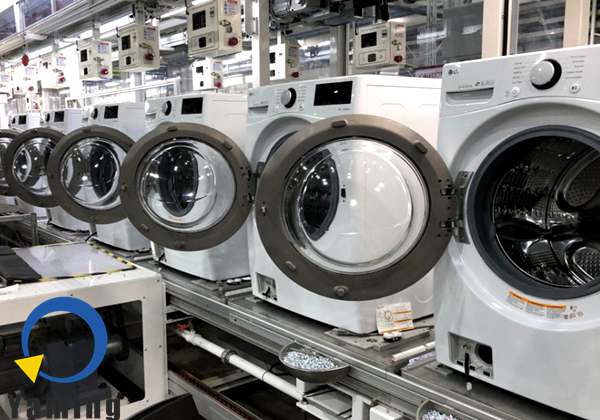
This series of Washing Machine Assembly Lines adopts a combined configuration of double-speed chain conveyors and roller conveyors, adapting to precision assembly and finished product transfer requirements respectively:
- Double-speed Chain Conveyor: Suitable for assembly and transfer of light components such as controllers, operation panels, and sensors, with a single tooling pallet load capacity of ≥50kg, operating vibration amplitude of ≤0.03mm, and workstation positioning accuracy of ±0.5mm. The accumulation design enables independent start-stop of workstations, for example, accurately transferring control boxes from the insertion station to the cabinet installation station, or transferring qualified small components to the buffer area, avoiding damage to precision electronic components during transfer.
- Roller Conveyor: Specially designed for finished washing machine transfer, with a single roller load capacity of ≥100kg and overall line load capacity of ≥500kg. The roller surface is rubber-coated (friction coefficient ≥0.6) to prevent scratches on the washing machine shell. It is mainly used for finished product transfer from the testing area to the packaging line, and from the packaging area to the warehouse entrance, supporting 24-hour continuous operation.
3. Core Process Flow of Washing Machine Assembly Line
The Washing Machine Assembly Line connects each assembly and testing workstation through the conveying system, realizing full-process automation from component loading to finished product off-line:
- Inner Drum Assembly: Sequentially complete outer drum sealing, inner drum installation, and lifting rib fixing, controlling inner drum coaxiality within ≤0.05mm to ensure uniform distribution of dehydration holes.
- Drive System Integration: Complete installation of motor, clutch, pulley, and belt tension adjustment to ensure smooth transmission with noise ≤60dB.
- Control System Assembly: Install electrical components including main control board, display screen, and water level sensor, complete wiring connection and continuity testing to ensure accurate program control.
- Water Inlet/Drainage System Installation: Install water inlet valve, drainage pump/drainage valve, connect water inlet and drainage pipes, and calibrate water control accuracy with the water level sensor.
- Cabinet and Door Assembly: Install the shell, door body, and sealing components, conduct door seal leakage testing to ensure no water leakage risk.
- Performance Testing: Complete full-performance testing including washing, dehydration, and drying (for models with drying function) sequentially, with unqualified products rejected in real time.
- Packaging and Off-line: Qualified washing machines are protected with packaging, labeled, palletized, and transferred to the finished product warehouse.
4. Core Advantages of Automated Washing Machine Assembly Line
- Significantly Improved Assembly Efficiency: The automated assembly line can produce 60-100 washing machines per hour, 3-5 times the capacity of manual production lines, with a single-shift capacity of 480-800 units.
- Significant Reduction in Comprehensive Costs: A single Washing Machine Assembly Line reduces front-line operation positions by over 70%, lowering long-term labor costs. Automated grabbing reduces component damage, and improved product consistency lowers after-sales failure rates by over 40%.
- Stable and Controllable Product Quality: Full-process standardized operation avoids the randomness of manual operations, with a first-pass product yield of ≥99%, meeting the access standards of major global markets.
- Outstanding Flexible Production Capability: Supports mixed-line production of front-load, top-load and other multi-model washing machines. Through rapid replacement of tooling fixtures and adjustment of program parameters, model changeover can be completed within ≤20 minutes, adapting to customized production demands of multi-variety and small-batch orders.
5. Reference Technical Parameters
|
Parameter Item |
Double-speed Chain Conveyor Configuration |
Roller Conveyor Configuration |
|---|---|---|
|
Core Conveying Form |
Double-speed chain conveyor |
Roller conveyor |
|
Single Tooling Pallet/Roller Load |
≥50kg |
≥100kg |
|
Applicable Operation Stage |
Precision component assembly and transfer |
Finished washing machine transfer |
|
Workstation Positioning Accuracy |
±0.5mm |
±1mm |
|
Operating Vibration Amplitude |
≤0.03mm |
≤0.05mm |
|
Hourly Production Capacity |
60-100 units |
60-100 units |
|
Model Changeover Time |
≤20 minutes |
≤20 minutes |
|
First-pass Product Yield |
≥99% |
≥99% |