Specialized in HA assembly line, motor assembly line, vehicle assembly line agricultural machinery assembly line
Email:[email protected]

Quotation Hotline
+86 135-2083-2251Specialized in HA assembly line, motor assembly line, vehicle assembly line agricultural machinery assembly line
Email:[email protected]
Quotation Hotline
+86 135-2083-2251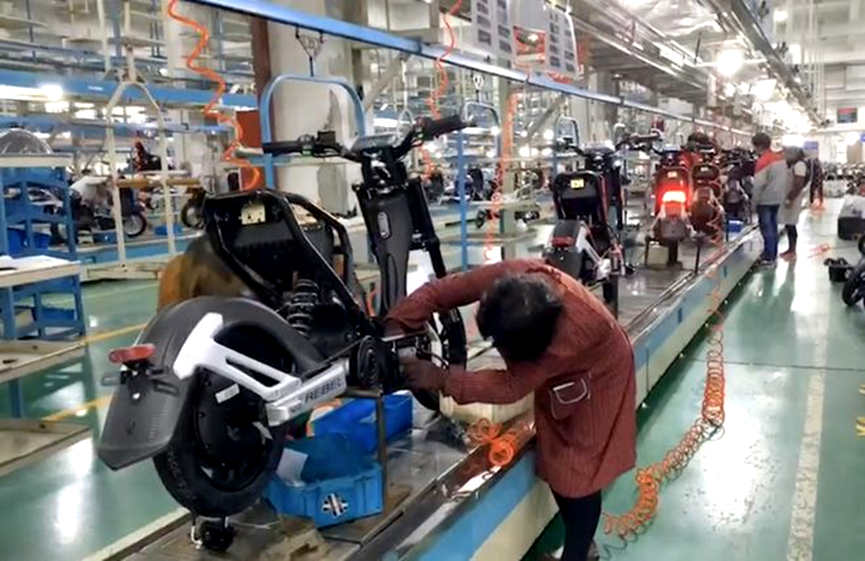
A retro electric scooter assembly line or general e-scooter production line is defined less by vehicle weight and more by part count: front apron, head cover, side panels, under-seat bucket, floor mats, chrome/matte trim, LCD or TFT instrument, keyless module, Bluetooth/APP, CAN/485 controller network, and often lithium battery in the seat box.
Typical products:
Long-tail variants: retro electric scooter assembly line, e-scooter production line, electric scooter manufacturing line, under-seat battery assembly line, scooter plastic-parts final assembly line, e-scooter BMS EOL line, electric two-wheeler SOP torque line.
Same structural platform as the heavy line, tuned for plastic logistics and electronic error-proofing.
Example 13 paired stations, expandable to 20+ for high-trim retro models.
A. Frame and floor-pan loading
Painted frame placed on plate-chain fixture. For scooters, fixture supports head tube, rear frame and floor pan; center-stand locator simulates final stance. Scan frame QR/VIN, open BOM on SOP. Visual check of weld, coating, harness channels and plastic-mounting bosses.
B. Front-end steering and fork
Press steering cups if tubular head tube; for scooter leg-shield/dual-link front ends, install linkage, fork, mudguard bracket. Torque stem and fork clamp per model. Because retro scooters often hide cables inside the head cover, leave extra harness loop and mark routing before trim closure.
C. Rear drive and swingarm
Install swingarm, twin or mono shock, hub motor wheel set. Scooter hub motors are usually pre-assembled with tire, disc/drum and phase harness. Check sprocket/belt pulley runout <0.5 mm, torque axle and motor stator mount where applicable. For belt scooters, set belt tension by manufacturer gauge; for chain scooters, set sag per spec.
D. Three-electric pre-assembly
Mount controller under floor or in rear body, DC-DC, alarm, keyless ECU, diagnostics. Pre-wire BMS. On lithium lines, use grounded fixture, wrist strap, ion fan, anti-static table mat; keep magnets, metal chips and cell debris away from BMS boards.
E. Battery box and locking
Retro scooters usually use under-seat battery. Install tray, slides, latch, interlock; insert pack; verify BMS communication, SOC, temperature sensors and insulation resistance. For swappable models, test cabinet docking pins and automatic lock. Record pack serial to VIN.
F. Harness, CAN/485 and instrument
Bind main harness along floor pan and head tube; plastic-clip spacing per design, conservative shop standard ≤300 mm for main trunk, tighter for battery/high-current branches. Connect controller, motor, instrument cluster, throttle, brake switches, lighting, GPS, Bluetooth/Wi-Fi. Configure CAN nodes: speed limit class, odometer calibration, keyless pairing, firmware version. 485 used for simpler BMS/diagnostic tools. Validate no fault codes before trim closing.
G. Handlebar, switches, keyless
Install retro-style handlebar or integrated control head; combination switch, throttle, brake levers, mirror, horn button, smart-card/phone-key antenna. Torque handlebar clamp per model; example light-assembly charts show around 18–30 N·m for stem/handlebar items, but scooter clamp size and material may require a different approved value. Check indicator, pass-light, hazard, regenerative mode button.
H. Brake integration
Drum scooters: shoe gap, cable free play, torque shoe axle.
Disc scooters: caliper, master, hose; bleed; torque banjo and mounting bolts; save curve. Because scooter body panels wrap close to brake lines, check hose routing under apron and leg shield to avoid chafing.
I. Plastic parts and interior/exterior trim
Overhead baskets deliver:
Use soft-fixtured supports, no metal direct contact. Quick-change locating pins adapt 2–4 scooter families. Control panel gap and flushness by feeler gauge and SOP photo; typical audit uses 0.5–1.5 mm target depending on class, but customer APQP standard governs. Re-check keyless antenna and instrument not squeezed by head cover.
J. Lighting, horn, security, initial power-on
Install LED head/tail/turn/license, horn, alarm, GPS. Power-on self-test: instrument boot, beam cutoff, turn 1–2 Hz, brake-light activation from both levers, keyless unlock, APP connect sample. SOP shows expected DTC list; any fault returns to electrical station.
K. Torque audit, function and water-check
Audit steering, fork, swingarm, motor, wheel, brake, battery lock. For wet-market scooters, perform spray test on connectors, head cover seams, under-seat gasket; check controller/IP rating per specification, commonly IP67 request on electronic modules. Apply torque dots.
L. EOL roller and delivery
Roller dynamometer for speed, current, regenerative brake; brake-distance check; light intensity; BMS report; charger handshake; keyless/immo final learn. Print conformity label, archive VIN+torque+CAN log, send to packing by overhead chain or ground roller.
Scooter bodies have many separate plastic parts. If all panels are moved by ground trolley, aisles become congested and panel damage rises. Overhead baskets decouple logistics from the operator: the apron arrives at Station I, side covers at Station I+1, under-seat bucket at Station E/F. Suspension speed is slaved to plate-chain takt so a basket is present but not blocking. Where ceiling height is low, use side roller racks with scheduled kitting instead of full overhead.
Can one line build retro scooter and small e-motorcycle?
Yes if wheel diameter, frame width and battery position are within fixture range. Scooter-dominated lines keep 660–710 mm and more trim stations; adding motorcycles needs wider chain, stronger drive and more brake/torque stations.
What torque system is enough?
For scooters, 6–12 smart torque tools covering steering, swingarm, motor, wheel, brake, battery lock. All safety curves go to MES; non-safety trims can use calibrated manual tools under SOP.
How to avoid plastic gap complaints?
Fix locator datums on fixture, not on operator feeling; use overhead delivery so panels are not bent; SOP photos with tolerance; final gap audit at trim station before torque sign-off.
Is lithium mandatory anti-static?
For lithium BMS/package stations, yes—grounded fixture, ion fan, straps, separate debris control. Lead-acid or small sealed-lead models can reduce anti-static scope but still need insulated tools for high-current terminals.