Specialized in HA assembly line, motor assembly line, vehicle assembly line agricultural machinery assembly line
Email:[email protected]

Quotation Hotline
+86 135-2083-2251Specialized in HA assembly line, motor assembly line, vehicle assembly line agricultural machinery assembly line
Email:[email protected]
Quotation Hotline
+86 135-2083-2251Air Conditioning Assembly Line System Process Analysis
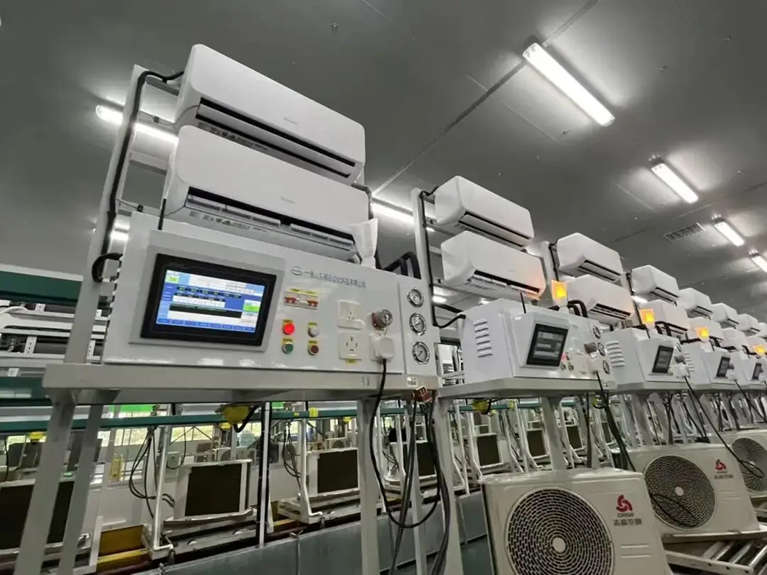
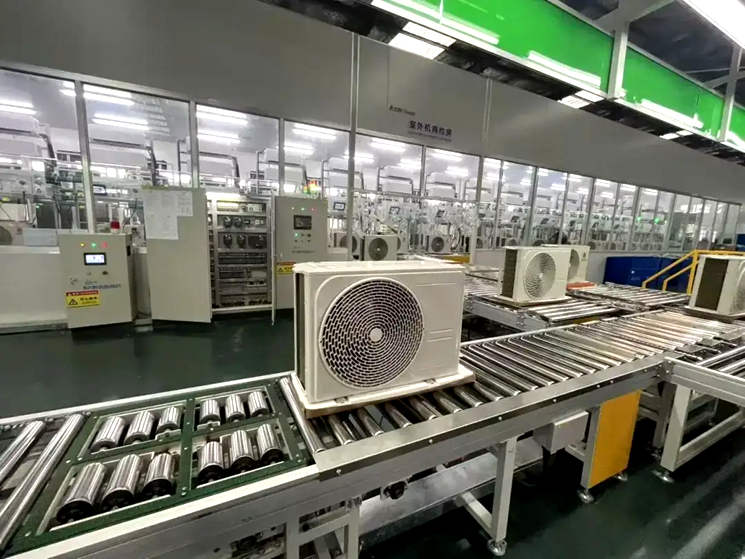
The air conditioning assembly line operates as a highly integrated discrete manufacturing system, typically configured in either U-shaped or linear modular layouts. The complete production line consists of six functional segments: sheet metal processing, heat exchanger fabrication, compressor installation, final assembly integration, performance testing, and packaging/offloading. These segments are interconnected via chain-driven conveyor systems or AGV-based intelligent logistics networks. Modern AC assembly lines incorporate MES (Manufacturing Execution Systems) to capture production cycle time, process parameters, and quality data in real time, establishing a closed-loop lifecycle management system from raw materials to finished products.
The front end of the production line is equipped with CNC punching machines, press brakes, and welding robots to stamp, bend, and weld air conditioner housings, ensuring precise dimensional accuracy of sheet metal components. The heat exchanger production line encompasses copper tube cutting, bending, expansion, fin insertion, and brazing operations. Automated equipment precisely controls copper tube processing dimensions and weld quality, directly impacting the unit’s heat exchange efficiency and long-term reliability.
As the “heart” of the refrigeration system, the compressor station utilizes automated conveying equipment and assembly robots working in tandem to perform automated loading, positioning, installation, and fastening. This station is equipped with torque monitoring systems that track and record the tightening torque of mounting bolts in real time, preventing transport vibration or operational noise caused by uneven torque distribution. Some advanced production lines have introduced AI-driven automatic assembly technology, where robotic arms equipped with intelligent algorithms improve assembly efficiency by 30% while achieving zero-defect operation.
Copper tube connections between the evaporator, condenser, and compressor represent a critical assembly stage. This process employs high-frequency welding or automated brazing techniques, requiring joints to exhibit both mechanical strength and zero micro-leakage. After welding, the system proceeds to vacuum evacuation and refrigerant charging stations, where vacuum pumps first remove all air and moisture from the piping circuit, followed by precise injection of environmentally compliant refrigerant. Charging accuracy directly affects cooling performance and energy consumption, which is why these stations utilize high-precision mass flow meters with closed-loop control systems.
The control board installation station integrates mainboards, sensors, and wiring harnesses into the unit chassis. This stage requires precise alignment of all connectors and intact insulation on every conductor. Modern AC control boards manage temperature sensing, airflow regulation, energy-saving mode switching, and smart connectivity functions. After assembly, dedicated harness testing equipment verifies each function—airflow direction, lighting, alarm signals, etc.—individually to ensure a zero-defect electrical system.
The assembly line implements multiple layers of quality assurance: post-weld high-pressure gas retention tests for leak detection; pressure withstand tests after refrigerant charging to verify system pressure capacity and sealing integrity; finished product performance test stations measuring cooling capacity, heating capacity, energy efficiency ratio, and noise levels; and electrical safety tests covering ground resistance, insulation resistance, dielectric strength, and leakage current. Some premium production lines deploy AI-powered comprehensive inspection systems and unmanned silent testing solutions, enabling automatic interception and traceability of defective products.
Air conditioning assembly lines are transitioning from labor-intensive to technology-intensive operations. Intelligent vision systems, using 20-megapixel industrial cameras, capture workpiece images, extract features through algorithmic processing, identify component orientations, and guide robots in precise pick-and-place and assembly operations. Digital twin technology synchronizes physical and virtual factory operations for real-time production optimization. Torque-angle compound control fastening mechanisms adaptively adjust parameters for lightweight materials such as aluminum-magnesium alloys to prevent thread stripping. Flexible fixture designs enable rapid changeover between multiple product specifications, with width adjustments completed within 10 seconds. Through process balancing optimization, intelligent production lines have demonstrated efficiency improvements exceeding 86%.
The air conditioning assembly line is a composite manufacturing system integrating mechanical precision assembly, refrigeration process control, electrical system integration, and intelligent inspection technology. From sheet metal stamping to finished product offloading, the precision control and process stability at each stage directly determine the performance and service life of the end product. As smart manufacturing technology continues to advance, air conditioning assembly lines are evolving toward higher automation rates, greater production flexibility, and more comprehensive data traceability systems.
If you have any questions or needs about the automated assembly line, please contact us via email: [email protected]