1. Air Conditioning Classification and Assembly Requirement Differences
As core household appliances for regulating indoor environments, air conditioners are divided into three categories according to product structure and application scenarios. The assembly difficulties of different categories directly determine the process configuration logic of the Air Conditioning Assembly Line:
- Household Split Air Conditioners: Including wall-mounted and cabinet units, with an annual output of over 100 million units. The core assembly difficulty lies in the sealing control of the refrigeration system and the assembly precision of indoor-outdoor unit connecting pipes, requiring the assembly line to have high capacity and stable consistency for mass production.
- Household Central Air Conditioners: Including ducted units and multi-split systems, the core assembly difficulty lies in the assembly precision of heat exchanger fins and the welding quality of refrigerant pipes, requiring the assembly line to have high-precision positioning capability to meet strict energy efficiency standards.
- Commercial Air Conditioners: Including modular units and screw units, with a single unit weight of 200-500kg. The core assembly difficulty lies in heavy component lifting and high-pressure refrigerant system sealing, requiring the assembly line to have heavy-load carrying capacity and a high-cleanliness working environment.
2. Core Conveying System of Air Conditioning Assembly Line (Plate Chain Conveyor)
This series of Air Conditioning Assembly Lines adopts a plate chain conveyor as the core ground conveying carrier, specially designed for precision assembly of air conditioner components and transfer of heavy finished units:
The plate chain conveyor adopts a steel chain plate + high-strength traction chain structure, with a single chain plate load capacity of 200-500kg and an overall line load capacity of ≥1000kg, meeting the transfer requirements of heavy components such as air conditioner outdoor units. The line body adopts an accumulation design: the tooling pallet carries components such as outdoor unit shells, heat exchangers, and compressors, transferring linearly along the guide rail. When the pallet reaches the corresponding workstation, the photoelectric sensor triggers a stopper to stop the pallet automatically, allowing workers to complete precision assembly in a static environment.
The plate chain conveyor surface is oil-resistant and high-temperature resistant, adapting to harsh working environments such as post-welding shell transfer and pre-treatment. For example, it can stably transfer welded outdoor unit shells from the welding area to the pre-treatment area, avoiding component collision damage. Compared with conveying solutions such as double-speed chains and roller conveyors, the high rigidity and heavy-load characteristics of the plate chain make it more suitable for heavy component transfer and multi-process connection in air conditioner production, making it the mainstream choice for Air Conditioning Assembly Lines.
3. Core Process Flow of Air Conditioning Assembly Line
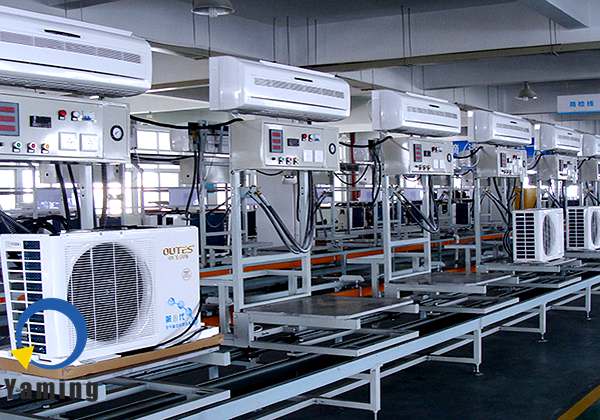
The Air Conditioning Assembly Line connects each assembly and testing workstation through the conveying system, realizing full-process automation from component loading to finished product off-line:
- Component Pre-treatment: Complete cleaning, anti-rust treatment and precision inspection of outdoor unit shells, heat exchangers, compressors and other components to ensure no impurities and no bumps.
- Core Component Assembly: Sequentially complete compressor fixing, condenser installation, fan motor assembly, capillary tube connection and other processes to ensure all components are firmly connected and meet position precision requirements.
- Refrigeration System Connection: Complete cutting, flaring, welding and sealing of indoor-outdoor unit connecting copper pipes, with a welding pass rate of ≥99.9%, ensuring no leakage in the refrigeration system.
- Electrical System Integration: Complete installation and wiring of main control board, sensors, relays, connecting harnesses, conduct circuit continuity testing and insulation testing to ensure normal control functions of the electrical system.
- Finished Product Performance Testing: Complete 12 testing items sequentially, including cooling/heating performance testing, energy efficiency ratio testing, noise testing, and safety protection function testing, with unqualified products rejected in real time.
- Packaging and Off-line: Qualified air conditioners are protected with packaging, labeled, palletized, and transferred to the finished product warehouse.
4. Core Advantages of Automated Air Conditioning Assembly Line
- Significantly Improved Assembly Efficiency: The Air Conditioning Assembly Line supports 24-hour continuous stable operation, compressing the production cycle of a single air conditioner from 40-60 minutes of manual assembly to 15-20 minutes, with single-shift capacity increased by over 150%.
- Stable and Controllable Product Quality: Full-process standardized operation reduces the refrigeration system leakage rate from 1% of manual production to below 0.1%, and increases the energy efficiency ratio pass rate to 99.8%, meeting the energy efficiency access standards of major global markets.
- Outstanding Flexible Production Capability: Supports mixed-line production of wall-mounted units, cabinet units, ducted units and other multi-category products. Through rapid replacement of tooling fixtures and adjustment of program parameters, model changeover can be completed within ≤30 minutes, meeting customized production demands such as specific color panels and intelligent networking functions.
- Significant Reduction in Comprehensive Costs: A single Air Conditioning Assembly Line can reduce front-line operation positions by 60%-70%, lowering long-term labor costs. Automated welding and assembly reduce material waste, and improved product consistency lowers after-sales quality costs.
5. Reference Technical Parameters
|
Parameter Item |
Configuration Description |
|---|---|
|
Core Conveying Form |
Plate chain conveyor |
|
Single Chain Plate Load |
200-500kg |
|
Workstation Positioning Accuracy |
±1mm |
|
Operating Vibration Amplitude |
≤0.05mm |
|
Production Cycle per Unit |
15-20 minutes |
|
Refrigeration System Leakage Rate |
≤0.1% |
|
Energy Efficiency Ratio Pass Rate |
≥99.8% |
|
Model Changeover Time |
≤30 minutes |
|
Reduction in Labor Demand |
60%-70% |