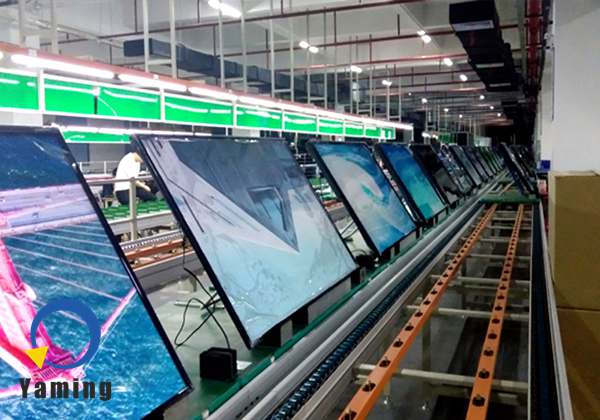
The assembly of LCD/LED televisions is a multi-stage operation involving the handling of precision components, electrical connections, and complete unit testing. The choice of conveyor system directly determines the cycle time and yield rate of the entire production line. This LCD TV Assembly Line employs a double-speed chain conveyor as the main line body, integrated with anti-static work boards and dedicated station equipment, to provide an efficient, flexible, and stable automated assembly solution for the LCD TV Assembly Line.
I. Basic Structure of LCD/LED Televisions
The assembly process of LCD/LED TVs is determined by their product structure. A complete television consists of four main components:
- Display Module: The core of TV imaging. The panel is composed of a backlight layer, liquid crystal layer, polarizers, etc., and works with a driver board and cable interfaces to produce images. Panels are fragile and expensive, requiring the highest level of protection during handling and assembly.
- Power Supply Board: Converts AC mains power into the DC voltages required by various TV components, providing power to the entire unit.
- Main Board: Integrates the CPU, memory, and interface circuits. It is responsible for signal processing, system operation, and external device connectivity.
- Housing and Frame: Includes the front bezel (secures the screen), rear cover (protects internal components), and stand. Typically made of plastic or metal, balancing aesthetics with protection.
The above structure dictates that TV assembly must sequentially complete component installation, electrical connections, and complete unit testing. This requires a conveyor line that can both support the weight of the complete unit and flexibly adapt to mixed-model production of multiple TV sizes.
II. Double-Speed Chain Conveyor System: The Core of the LCD TV Assembly Line
This LCD TV Assembly Line adopts a double-speed chain conveyor (also known as a differential chain conveyor) as the main line, equipped with anti-static work boards. The double-speed chain is a gravity-flow conveying system and is one of the most widely used conveyor forms in the assembly of household appliances such as televisions, monitors, and air conditioners.
Working Principle: The motor drives the chain to run at a constant low speed. Through a diameter differential design between the chain rollers and the load-bearing wheels, the actual travel speed of the work board can reach 2 to 3 times the chain’s own speed, allowing workpieces to move quickly between stations. The chain itself runs at low speed, resulting in minimal wear and a long service life. When a work board reaches a designated station, a stopper halts and positions it for assembly work. Once the stopper is released, conveying resumes. Thanks to the accumulation design, a stop at one station does not affect the operation of other stations on the line, enabling flexible free-cycle production.
Structural Composition: The line body consists of a double-speed chain, surface-treated extruded aluminum alloy profile rails, a frame, a drive unit, a tensioning device, and a control system. It can be integrated with dedicated machines such as lift-and-transfer units and lift-and-rotate units to form horizontal or vertical circulation systems. The work boards have a load capacity of 30–50 kg, meeting the transfer requirements for TV rear covers, front bezels, and complete units between stations. The surface of the work boards is treated for anti-static properties, preventing damage to panels and electrical components during transit.
Typical Process Flow of the LCD TV Assembly Line: Rear Cover Loading → Power/Main Board Fixing → Cable & Interface Assembly → Screen Assembly → Power-On Aging Test → Safety Compliance Test → Visual Inspection → Packaging & Off-Line. Work boards carry the workpieces as they circulate between stations—for example, from the rear cover installation station to the main board fixing station, or directly to the testing area after casing assembly—eliminating the need for manual handling throughout the entire LCD TV Assembly Line.
III. Core Advantages of the LCD TV Assembly Line
- Significant Efficiency Improvement: The production cycle per TV on a manual line is approximately 30–40 minutes, which can be reduced to 10–15 minutes on an automated line.
- Stable & Controllable Quality: Automated equipment offers high assembly precision. The display defect rate drops from approximately 2% in manual production to below 0.1%, while the safety test pass rate increases to 99.9%.
- Flexible Production Capacity: Supports mixed-model production of different sizes (32–75 inches) and configurations (smart/non-smart), accommodating customization requirements such as brand logos and interface configurations.
- Continuous Cost Optimization: In the long term, manual labor input can be reduced by 70%–90%, and material loss rates for PCB boards, display panels, etc., can be reduced from 5% to below 1%.
IV. Contact Us
If you have any questions or requirements regarding the LCD TV Assembly Line, please feel free to contact us.
Email: [email protected]