1. Motorcycle Classification and Assembly Requirement Differences
As a core vehicle for short-distance commuting and recreational use globally, motorcycles are divided into four categories according to structural design and power type. The assembly difficulties of different categories directly determine the process configuration logic of the Motorcycle Assembly Line:
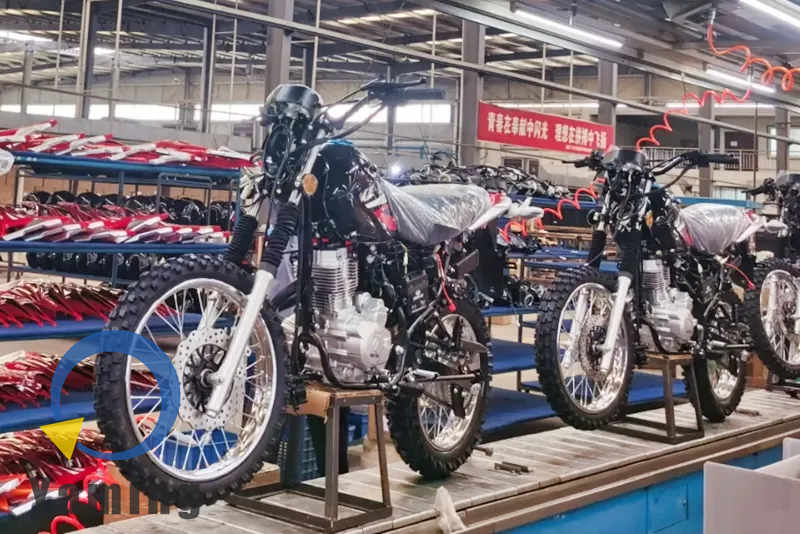
- Straddle Motorcycles: With a displacement range of 125-1000cc, they adopt a double-tube steel frame and have a curb weight of 80-200kg, serving as the mainstream commuting model in Southeast Asian and South American markets. The core assembly difficulty lies in the coaxiality control of the engine and frame, as well as transmission system calibration, requiring the assembly line to have heavy-load carrying capacity for heavy engine lifting.
- Scooter (Step-through) Motorcycles: With a displacement range of 50-400cc, they adopt an integrated load-bearing frame and have a curb weight of 60-150kg. The core assembly difficulty lies in the control of assembly gaps for front storage boxes and footrests, requiring the assembly line to have high-precision positioning capability to meet the consistency requirements of appearance parts.
- Underbone Motorcycles: With a displacement range of 100-150cc and a curb weight of 50-100kg, they target the cost-effective commuting segment. The core assembly difficulty lies in the welding precision of the underbone frame and the consistency of engine installation, requiring the assembly line to have high-capacity and low-cost characteristics for mass production.
- Electric Motorcycles: With a power range of 1-10kW, they are equipped with a three-electric system (battery, motor, electronic control). The core assembly difficulty lies in high-voltage insulation protection and reasonable wiring harness layout, requiring the assembly line to have insulation testing and high-voltage interlock testing capabilities to meet the safety standards for new energy vehicles.
The structural differences between these categories are the core basis for the flexible design of the Motorcycle Assembly Line, requiring targeted matching of conveying solutions and assembly processes.
2. Core Conveying System of Motorcycle Assembly Line
This series of Motorcycle Assembly Lines can be configured with three mainstream conveying solutions according to vehicle load and capacity requirements. All solutions adopt an accumulation design, allowing static operation at workstations to avoid assembly deviation caused by component shaking:
- Plate Chain Conveyor: Suitable for straddle and large-displacement motorcycle assembly, it adopts a steel chain plate + high-strength traction chain structure, with a single chain plate load capacity of ≥300kg and an overall line load capacity of ≥1000kg. The operating vibration amplitude is ≤0.05mm, and the workstation positioning accuracy is ±1mm. When the tooling pallet carrying the frame reaches the corresponding workstation, the photoelectric sensor triggers a stopper to stop the pallet automatically, allowing workers to complete precision processes such as engine marriage and transmission system calibration in a static environment.
- Double-speed Chain Conveyor: Suitable for scooter, underbone and small-to-medium displacement electric motorcycle assembly, it uses a 3x speed roller chain for transmission, with a single tooling pallet load capacity of ≥150kg. The operating vibration amplitude is ≤0.03mm, and the workstation positioning accuracy is ±0.5mm. The accumulation characteristic supports mixed-line production of multiple models, and only fixture adjustment is required for model changeover, meeting multi-SKU production demands.
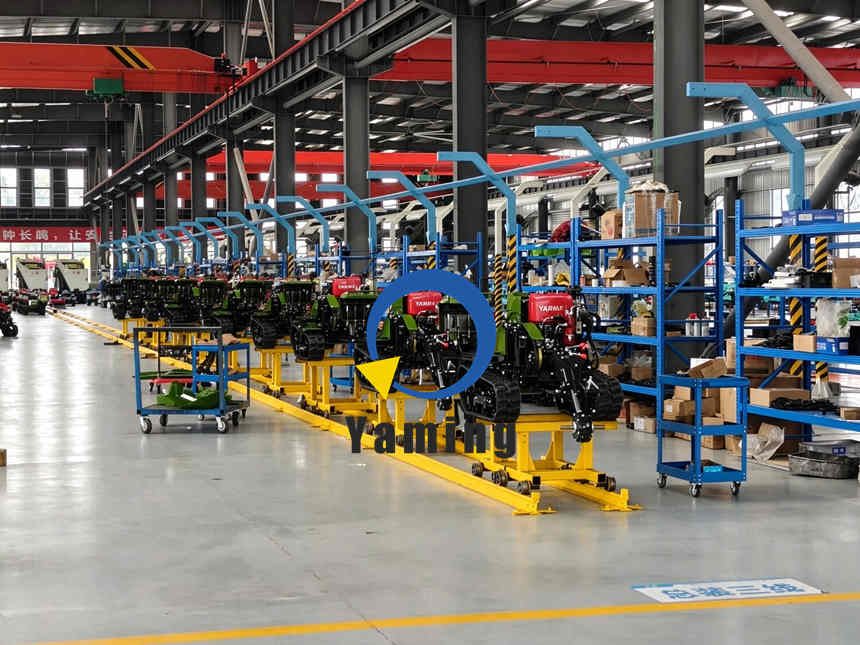
- Chain Drag Conveying System: A dedicated long-line conveying solution for Motorcycle Assembly Lines, the traction chain is arranged in an underground groove to pull the frame-carrying tooling pallet along the track. It does not occupy ground operation space, with an adjustable running speed of 0.5-5m/min, and supports line lengths of 200-500 meters, adapting to high-capacity demands of over 400 units per shift.
All three conveying solutions can work in coordination with RGVs (Rail Guided Vehicles) and overhead suspension conveyors to realize automatic delivery of heavy components such as engines, wheels and batteries, reducing manual handling time by over 30%.
3. Core Equipment and Technologies of Motorcycle Assembly Line
The Motorcycle Assembly Line combines standardized processes with automated equipment to realize full-process efficient assembly:
- Modular Flexible Changeover Technology: For mixed-line production of straddle, scooter, electric motorcycles and other models, rapid changeover is realized through switchable positioning fixtures and adjustable tooling pallets, with a changeover time of ≤20 minutes. It adapts to differences in frame size and power unit mounting positions of different models without large-scale line modification.
- High-precision Electro-pneumatic Tools: The whole line is equipped with torque-controlled electro-pneumatic tightening equipment, with a torque error of ≤±2%. All tightening data is uploaded to the MES system for 100% traceability, replacing manual tightening to reduce human error and improve assembly consistency.
- 360° Rotating Assembly Platform: Each workstation is equipped with a rotating platform with a load capacity of ≥200kg, which can rotate the motorcycle frame 0-360° to any angle. This facilitates workers to complete processes such as bottom engine installation, wiring harness connection and exhaust pipe fixing, reducing labor intensity and improving assembly precision.
- Automated Assembly and Testing Equipment: Industrial robots are used to complete repetitive processes such as welding, handling and tightening, with a repeat positioning accuracy of ±0.1mm and an efficiency improvement of 200% compared with manual operation. AI visual inspection equipment conducts 100% online testing of key parameters such as frame weld spots, appearance scratches and assembly gaps (≤0.3mm), rejecting unqualified products in real time to prevent defective products from flowing into the next process.
- Standardized Workstation Configuration: The whole line is equipped with standard auxiliary facilities including LED lighting, workstation fans, air pipelines, power sockets and tool cabinets, providing a comfortable working environment for workers and reducing invalid labor hours.
4. Core Advantages of Motorcycle Assembly Line
- Significantly Improved Production Efficiency: The Motorcycle Assembly Line supports 24-hour continuous operation, with a single-shift capacity of 150-400 units, 80% higher than traditional manual assembly. The production takt can be flexibly adjusted between 60-120 seconds per unit to meet the demands of different order volumes.
- Stable and Controllable Product Quality: Full-process standardized operation combined with AI online inspection ensures a first-pass product yield of ≥99%, far higher than the 92% yield of manual assembly, meeting the access standards of target markets such as Southeast Asia, South America and Europe.
- Strong Flexible Adaptability: It supports mixed-line production of straddle, scooter, underbone and electric motorcycles, with a model changeover time of ≤20 minutes, enabling rapid response to personalized market orders and reducing switching costs for multi-variety production.
- Significant Reduction in Comprehensive Costs: A single Motorcycle Assembly Line can reduce the demand for front-line operation positions by over 40%, lowering long-term labor costs. Automated equipment replaces high-risk operations such as heavy component handling and high-intensity tightening, reducing safety accident risks by over 90%.
5. Reference Technical Parameters
|
Parameter Item |
Plate Chain Conveyor Configuration |
Double-speed Chain Conveyor Configuration |
Chain Drag Conveyor Configuration |
|---|---|---|---|
|
Core Conveying Form |
Plate chain conveyor |
Double-speed chain conveyor |
Chain drag conveyor |
|
Single Tooling Pallet Load |
≥300kg |
≥150kg |
≥300kg |
|
Applicable Models |
Straddle, large-displacement motorcycles |
Scooter, underbone, electric motorcycles |
Full-category high-capacity production |
|
Workstation Positioning Accuracy |
±1mm |
±0.5mm |
±1mm |
|
Operating Vibration Amplitude |
≤0.05mm |
≤0.03mm |
≤0.05mm |
|
Single-shift Capacity |
150-250 units |
200-350 units |
300-400 units |
|
Model Changeover Time |
≤20 minutes |
≤20 minutes |
≤30 minutes |
|
First-pass Product Yield |
≥99% |
≥99% |
≥99% |
6. Contact Information
For inquiries about customized solutions, technical parameters or quotations for Motorcycle Assembly Lines, please contact us via email: [email protected]