1. Motor Classification and Assembly Requirement Differences
As the core power component of industrial automation, consumer electronics, new energy vehicles and other fields, motors are divided into four categories according to application scenarios and performance requirements. The structural characteristics and precision requirements of different categories directly determine the process configuration logic of the Motor Assembly Line:
- Industrial Drive Motors: Covering general industrial models such as machine tool motors and conveyor motors, with a power range of 0.5-500kW. The core assembly difficulties lie in stator winding insulation treatment, rotor dynamic balance calibration (unbalance ≤1g·cm), and bearing assembly precision control, requiring the assembly line to have high cleanliness and high-precision positioning capabilities for batch standardized production.
- Home Appliance Motors: Including washing machine motors, air conditioner compressor motors, refrigerator fan motors, etc., with a unit weight of 0.5-10kg and an annual demand of hundreds of millions of units. The core assembly difficulty lies in low-cost high-capacity output and consistent winding quality, requiring the assembly line to have high-speed operation capability, compressing the production cycle of a single unit to less than 10 seconds.
- New Energy Vehicle Motors: Including drive motors and auxiliary motors (such as electronic water pump motors and air conditioner compressor motors), with a power range of 30-300kW. The core assembly difficulties include high-voltage insulation system assembly (insulation resistance ≥100MΩ), coaxiality control of stator-rotor marriage (≤0.02mm), and NVH performance debugging, requiring the assembly line to have high cleanliness and full-process data traceability capability.
- Special Motors: Covering servo motors, stepper motors, explosion-proof motors, etc., with special requirements for positioning accuracy and safety performance. The core assembly difficulties lie in encoder calibration and sealing of explosion-proof structures, requiring the assembly line to have flexible model changeover capability to support small-batch multi-variety production demands.
2. Core Conveying System of Motor Assembly Line (Roller Conveyor)
This series of Motor Assembly Lines adopts a roller conveyor as the core carrier for finished product transfer and buffering, fully meeting the high-efficiency and low-loss requirements of the post-assembly stage of motor production:
The roller conveyor adopts a grouped drive design, which enables independent start-stop of single workstations, avoiding energy waste caused by idling of the whole line. The equipment energy consumption is more than 30% lower than that of traditional chain conveyors. The roller surface is coated with anti-slip rubber with a friction coefficient ≥0.6, which can effectively prevent scratches and collisions of motor housings during transfer, and is suitable for the transfer of full-category motors in the weight range of 10-500kg. The line body supports accumulation buffering, enabling sorting and temporary storage of different models of motors between the testing area and packaging line, and before warehousing, improving material flow efficiency.
Compared with conveying solutions such as plate chains and double-speed chains, the low-vibration and low-noise characteristics of roller conveyors make them more suitable for the precision transfer of finished motors, making them the mainstream choice for the post-stage of Motor Assembly Lines.
3. Core Process Flow of Motor Assembly Line
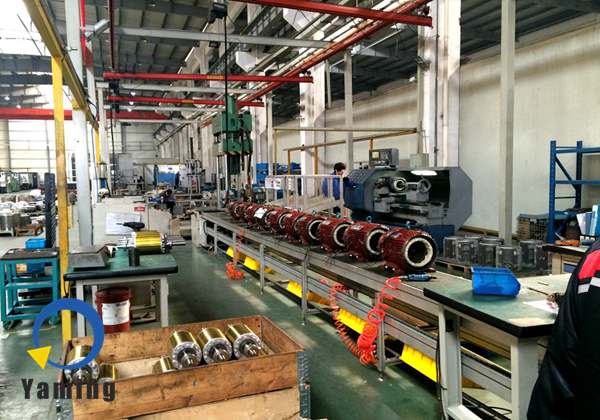
The Motor Assembly Line connects each assembly and testing workstation through the conveying system, realizing full-process automation from component loading to finished product warehousing:
- Stator Assembly: Complete processes such as stator core stacking, winding embedding, insulation varnish dipping, and lead wire welding, with winding precision error ≤±0.1mm and 100% insulation resistance testing.
- Rotor Assembly: Complete processes such as rotor core stacking, shaft pressing, dynamic balance calibration, and bearing assembly, with rotor unbalance controlled within ≤1g·cm.
- Stator-Rotor Marriage: Align the stator and rotor accurately, control the air gap uniformity ≤0.05mm, complete end cover assembly and bolt tightening, with tightening torque error ≤±2%.
- Performance Testing: Complete 12 testing items sequentially, including insulation resistance testing, no-load current testing, speed-torque testing, and NVH testing, with unqualified products rejected in real time.
- Finished Product Transfer and Buffering: Qualified motors are transferred from the testing area to the packaging line via the roller conveyor. Different models of motors can be temporarily stored in the buffering section of the roller line, waiting for warehousing sorting.
- Packaging and Off-line: Complete motor protective packaging, labeling, palletizing, and transfer to the finished product warehouse.
4. Core Advantages of Automated Motor Assembly Line
- High Automation Level: Processes with high repeatability and high precision requirements such as winding, precision assembly, and testing are all completed by automated equipment, reducing manual intervention by more than 80%, lowering labor intensity, and avoiding human operation errors.
- Excellent Consistency and Stability: Equipment runs according to preset programs, eliminating the randomness of manual operations. The first-pass product yield can reach over 99%, meeting the quality requirements of industrial-grade and automotive-grade motors.
- Outstanding Flexible Production Capability: Through rapid replacement of tooling fixtures and adjustment of program parameters, mixed-line production of different motor models in the weight range of 10-500kg can be realized, with model changeover time ≤30 minutes, adapting to the customized production demands of multi-variety and small-batch orders.
- High Efficiency and Energy Saving: After process connection optimization, material waiting time is reduced by 40%. The production cycle of a single home appliance motor can be compressed to the second level, and that of a single industrial motor is ≤5 minutes. The grouped-drive roller conveyor combined with an intelligent control system reduces the overall equipment energy consumption by more than 25%.
5. Reference Technical Parameters
|
Parameter Item |
Configuration Description |
|---|---|
|
Core Conveying Form |
Roller conveyor |
|
Applicable Motor Weight |
10-500kg |
|
Roller Surface Friction Coefficient |
≥0.6 (rubber-coated) |
|
Positioning Accuracy |
±1mm |
|
First-pass Product Yield |
≥99% |
|
Model Changeover Time |
≤30 minutes |
|
Operation Mode |
24-hour continuous operation, adjustable takt time |
|
Energy Consumption Reduction |
≥25% (compared with traditional chain conveyors) |