Industry Overview: EV Segments and Their Impact on Assembly Line Design
The electric vehicle industry has evolved into a diversified ecosystem, and the classification of EV products directly determines the configuration logic of the Electric Vehicle Assembly Line. Understanding these segment differences is essential for designing a production line that matches the target product mix.
Passenger EVs
Passenger electric vehicles—including sedans, SUVs, MPVs and crossover models—dominate global EV production, representing the largest share of the market. These models prioritize ride comfort, intelligent features, interior aesthetics and driving experience.
- Assembly line implications: Passenger EV assembly lines demand the highest automation density, with body-in-white structures weighing 200–400 kg and unibody constructions. The line must support rapid model changeovers, as OEMs typically launch 3–5 new platform variants annually. Particular attention is paid to interior trim refinement, panel gap consistency (≤0.3mm), and high-voltage system integration precision.
Commercial EVs
Commercial electric vehicles encompass logistics vans, light trucks, urban delivery vehicles, buses and heavy-duty trucks. They prioritize load capacity, operational durability and total cost of ownership rather than passenger comfort.
- Assembly line implications: Commercial EV bodies weigh 600–1,200 kg with reinforced frame structures. The assembly line requires heavier-duty fixtures, more powerful lifting equipment (battery packs often exceed 300 kg), and extended cycle times (60–90 seconds typical for structural welding). Modular chassis platforms must accommodate diverse cargo configurations, battery capacity variations and specialized equipment mounting, demanding higher flexibility in fixture design.
Power-Train Architecture Classification
Beyond application scenarios, EVs are also classified by their power-train architecture, each imposing distinct assembly requirements on the Electric Vehicle Assembly Line:
- BEV (Battery Electric Vehicle): Fully electric, with the battery pack serving as a structural component of the skateboard chassis. Assembly focuses on battery pack integration, e-governed high-voltage connections and thermal management.
- PHEV / EREV (Plug-in Hybrid / Extended-Range): Combines an electric drivetrain with an internal combustion engine, requiring dual powertrain assembly stations and more complex under-hood packaging.
- FCEV (Fuel Cell Electric Vehicle): Hydrogen-powered, adding high-pressure hydrogen tank installation, fuel cell stack integration and hydrogen leak detection protocols to the assembly process.
This diversity in EV product categories is precisely why a modern Electric Vehicle Assembly Line must be architected as a flexible, modular system—capable of absorbing battery pack integration stations, high-voltage testing protocols, and structural changes to general assembly that conventional ICE lines never required.
Electric Vehicle Assembly Line System
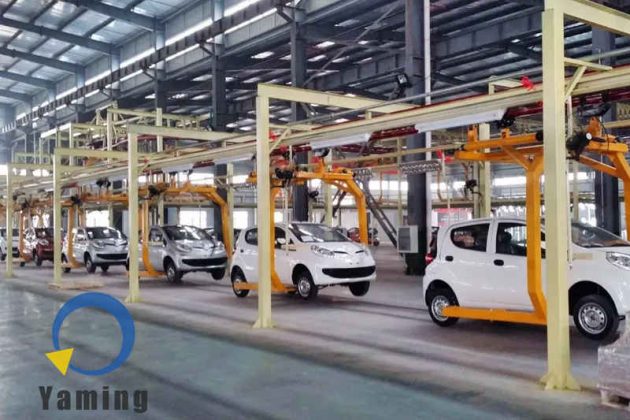
The Electric Vehicle Assembly Line is a production line that assembles various parts of an electric vehicle to finally form a complete vehicle. To meet the demands of EV-specific assembly, the line generally adopts a ground-rail type conveyor as the core ground transport carrier, supplemented by a suspended conveyor line for overhead logistics:
- Ground-rail type conveyor line: Consists of a metal skateboard, a chain/friction drive system, and a positioning mechanism. The body is placed on the skateboard and moves along the ground track. The ground-rail system is engineered to handle the substantial weight of battery-equipped chassis, with positioning accuracy within ±1mm to guarantee precise alignment during the critical marriage process.
- Suspended conveyor line: Consists of an aerial track, electric hoist and a control system. The body or parts are suspended and transported in the air, maximizing shopfloor space utilization and enabling ergonomic assembly postures.
Key Steps and Processes in the Electric Vehicle Assembly Line
- Combined assembly of battery pack and chassis: Align the chassis and battery pack through a lift or turntable, fix them with high-strength bolts, and complete the docking of high-voltage wiring harnesses and cooling pipes. Given that battery packs can weigh over 300 kg, this process mandates overhead lifting machinery and automated carriers to position the pack with microscopic precision beneath the chassis structure.
- Combined assembly of the body and the chassis: The chassis is lifted vertically by an electric hoist or hydraulic lift, aligned with the suspension point at the bottom of the body, and the bolts are automatically tightened to complete the integrated connection of the body and the chassis. This “marriage” point represents the most critical juncture of EV assembly, where the painted body seamlessly unites with the skateboard chassis containing the battery, e-motors, suspension and braking systems.
- High-voltage system integration: High-voltage wiring harnesses are arranged along the dedicated routing slot of the body to avoid moving parts. The 800V high-voltage architecture typical of modern EVs requires rigorous isolation management, with all high-voltage connections validated through insulation resistance testing (≥100 MΩ at 500V DC per ISO 6469-3).
- Electronic and electrical assembly: After fixing OBC (vehicle-mounted charger), DC/DC (high-voltage converter), VCU (vehicle controller), T-BOX (vehicle networking module) and other components, wire harness connection and software initialization are carried out. Unlike conventional vehicles, software flashing and calibration of dozens of ECUs are now as critical as the physical bolting process.
- Fine assembly of interior/exterior decoration: Collaborative robots are used to complete dozens of interior decoration assemblies such as instrument panels, seats, and doors. Premium-segment lines often deploy wire-harness installation on moving skates, while mass-volume lines utilize stationary-cell layouts to balance throughput and flexibility.
- Final inspection and offline: Strict quality testing ensures the excellent quality of each car. The finished EV undergoes a comprehensive EOL protocol, including a rolling road test to simulate driving dynamics, a high-pressure water booth to check for body seals, and—most critically—a full diagnostic check of the high-voltage battery and software systems before the vehicle is cleared for shipment.
Why Choose Our Electric Vehicle Assembly Line
Our Electric Vehicle Assembly Line solutions are engineered with a deep understanding of EV-specific manufacturing paradigms. We recognize that EV assembly introduces battery integration stations, high-voltage testing protocols, and structural changes that traditional automotive lines lack. We incorporate:
- Battery pack marriage stations with servo-controlled precision alignment and automatic high-torque fastening
- High-voltage safety management throughout the line, including isolated HV assembly zones and real-time insulation monitoring
- Thermal management integration stations for coolant connection between battery, e-motor and power electronics
- Flexible fixture architecture capable of accommodating varying battery pack sizes and multi-platform production
- MES-ready controls enabling software flashing, ECU calibration and full data traceability for every vehicle
Whether you are producing passenger EVs at high volume, building commercial electric fleets, or venturing into next-generation BEV/PHEV/FCEV platforms, our Electric Vehicle Assembly Line can be tailored to your specific product mix and capacity targets.
Contact Information
If you have any questions or needs about the automated Electric Vehicle Assembly Line, please contact us via email: [email protected]