1. Two-wheeled Vehicle Classification and Assembly Requirement Differences
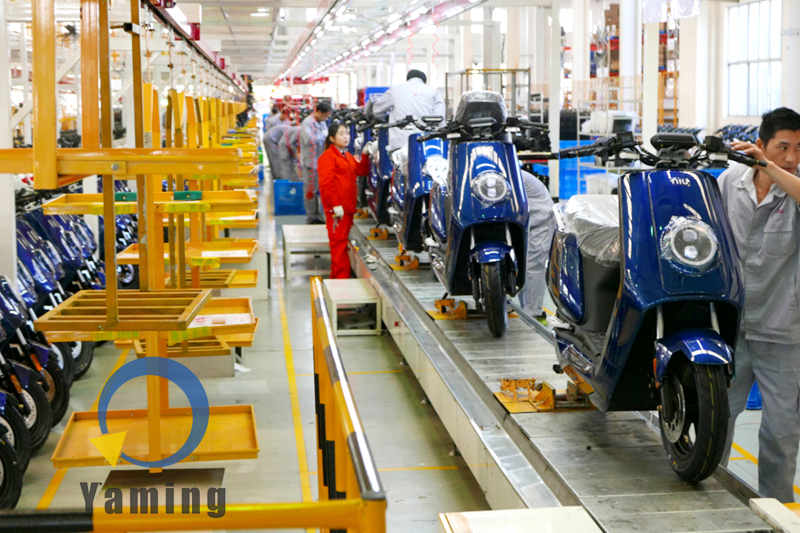
Two-wheeled Vehicle Assembly Lines cover three categories: motorcycles, bicycles, and electric two-wheelers. The power structure and assembly precision requirements of different categories determine the process configuration:
- Motorcycles: With a displacement of 50-1000cc and a curb weight of 60-200kg, the core assembly difficulty lies in coaxiality control of the engine and frame, as well as transmission system calibration, requiring the assembly line to have heavy-load carrying capacity.
- Bicycles: Non-powered, with a curb weight of 10-25kg, the core assembly difficulty lies in frame welding precision and transmission system debugging, requiring the assembly line to have high-takt production capacity for mass production.
- Electric Two-wheelers: With a power of 0.5-10kW, equipped with a battery, motor and electronic control system, the core assembly difficulty lies in high-voltage wiring harness insulation protection and three-electric system parameter calibration, requiring the assembly line to have insulation testing and high-voltage interlock testing capabilities.
2. Core Conveying System of Two-wheeled Vehicle Assembly Line
This series of Two-wheeled Vehicle Assembly Lines adopts plate chain conveyors and double-speed chain conveyors as core conveying carriers:
- Plate Chain Conveyor: Suitable for motorcycle and heavy electric two-wheeler assembly, it adopts a steel chain plate structure with a single chain plate load capacity of ≥300kg and an overall line load capacity of ≥1000kg. The operating vibration amplitude is ≤0.05mm, and the workstation positioning accuracy is ±1mm. The accumulation design enables independent start-stop of workstations, and the tooling pallet carrying the frame operates statically to avoid assembly deviation caused by heavy component shaking.
- Double-speed Chain Conveyor: Suitable for bicycle and light electric two-wheeler assembly, it uses a 3x speed roller chain for transmission, with a single tooling pallet load capacity of ≥150kg. The operating vibration amplitude is ≤0.03mm, and the workstation positioning accuracy is ±0.5mm. The accumulation characteristic supports mixed-line production of multiple models, requiring only fixture adjustment for model changeover.
3. Core Process Flow of Two-wheeled Vehicle Assembly Line
The Two-wheeled Vehicle Assembly Line connects each workstation through the conveying system, realizing full-process assembly from frame loading to finished product testing:
- Frame Assembly: The frame is fixed on the tooling pallet fixture of the line body, and the front fork, rear swing arm, and shock absorber are installed sequentially to ensure the overall frame structure is firm and stable.
- Powertrain Installation: Motorcycles: Install the engine and transmission assembly. Electric two-wheelers: Install the motor and battery pack, complete high-voltage wiring harness connection and insulation testing.
- Wheel Assembly: Front wheel: Assemble the tire and hub into a wheel set and install it on the front fork. Rear wheel: Electric two-wheelers align and fix the rear wheel with the motor; motorcycles connect the rear wheel with the engine drive chain.
- Transmission Component Installation: Bicycles/electric two-wheelers: Install the chain (or belt) and flywheel, and adjust the tension. Motorcycles: Install the chain cover and transmission gear, and check the meshing degree between the chain and gear.
- Electrical System Wiring: Complete wiring connection and continuity testing for all electrical components including headlights, taillights, instrument panels, and battery connections.
- Brake System Installation: Fix the brake disc (or brake drum) on the wheel set, fix the brake caliper (or brake pad) on the frame/front fork, connect the brake cable (or hydraulic pipe), and test the braking performance.
- Body Accessory Assembly: Install side panels, fuel tanks and other trim parts to the frame, then assemble remaining parts such as mirrors, seats and handlebars sequentially.
- Quality Inspection and Performance Testing: Online quality inspection is conducted at each assembly stage. Finished products undergo full-performance testing including engine function, braking performance, and electrical system function, with unqualified products rejected.
4. Core Advantages of Two-wheeled Vehicle Assembly Line
- Improved Production Efficiency: Supports 24-hour continuous operation, with a single-shift capacity of 150-400 units, 80% higher than manual assembly.
- Stable Product Quality: Full-process standardized operation ensures a first-pass product yield of ≥99%, meeting the access standards of major global markets.
- Strong Flexible Adaptability: Supports mixed-line production of motorcycles, bicycles and electric two-wheelers, with a model changeover time of ≤20 minutes.
- Reduced Labor Cost: A single line reduces front-line operation positions by over 40%, lowering long-term labor costs and safety risks.
5. Reference Technical Parameters
|
Parameter Item |
Plate Chain Conveyor Configuration |
Double-speed Chain Conveyor Configuration |
|---|---|---|
|
Core Conveying Form |
Plate chain conveyor |
Double-speed chain conveyor |
|
Single Tooling Pallet Load |
≥300kg |
≥150kg |
|
Applicable Models |
Motorcycles, heavy electric two-wheelers |
Bicycles, light electric two-wheelers |
|
Workstation Positioning Accuracy |
±1mm |
±0.5mm |
|
Operating Vibration Amplitude |
≤0.05mm |
≤0.03mm |
|
Single-shift Capacity |
150-250 units |
200-400 units |
|
Model Changeover Time |
≤20 minutes |
≤20 minutes |
|
First-pass Product Yield |
≥99% |
≥99% |